
 Posted by
 Being of German Jewish descent, raised as a Roman Catholic, I find Deism the most appealing one of the many ways to think about God and Nature. ‘Deism’, from the Latin term ‘deus’, meaning ‘God’, is a philosophical and religious perspective that emerged prominently in the 17th and 18th centuries during the European enlightenment. It posits or postulates that a supreme being that we name “God” created the universe and set it in motion according to rational, natural laws, but then stepped back and allowed its creation to run its course. A creator God as the “Watchmaker”.
Deists emphasize human reason, morality derived from nature, and skepticism toward organized religion, scriptures, and any form of dogmatic thinking, including secular ones, such as ideologies. They view the Bible as a historic document rather than as divine revelation, and reject concepts like the Trinity, the original sin (i.e. collective guilt), or the divinity of Jesus as “superstitions”.
Isaac Newton, whose structured universe suggested a designer, was a Deist and so was John Locke, who emphasized reason rather than faith. Deism spread among educated elites in Europe and the American colonies, appealing to those who wanted faith without the “superstitions” of traditional religion.
The religious beliefs of the Founding Fathers, i.e. the men who declared independence, wrote the Constitution, and shaped the early Republic, were diverse and often complex. They were not a uniform bloc of orthodox Christians, or of hardcore atheists, or of Deists. There has been much debate about the extent of Deist influence among the Founding Fathers. However, a relatively clear picture emerges from their writings, their letters, and their actions: many key figures were profoundly shaped by Deist ideas, even if they were not strict “watchmaker” Deists, who deny all divine involvement after creation.
Thomas Jefferson is the poster child for Deist-leaning thinking among the Founders. He admired Jesus as a moral teacher but rejected the ideas of miracles and the supernatural. In his later years, he literally cut and pasted the Gospel to create “The Life and Morals of Jesus of Nazareth” aka the “Jefferson Bible”, removing things like the virgin birth, resurrection, and divine claims and focusing instead on ethics and reason. He called himself a “Unitarian” or follower of a rational faith, but he was never a member of the Unitarian Church. The Declaration of Independence refers to “Laws of Nature”, “Nature’s God” and the “Creator“, which terms echo Deist thinking:
“When in the Course of human events, it becomes necessary for one people to dissolve the political bands which have connected them with another, and to assume among the Powers of the earth, the separate and equal station to which the Laws of Nature and of Nature’s God entitle them, a decent respect to the opinions of mankind requires that they should declare the causes which impel them to the separation.
We hold these truths to be self-evident, that all men are created equal, that they are endowed by their Creator with certain unalienable Rights, that among these are Life, Liberty and the pursuit of Happiness.”
Benjamin Franklin openly described becoming a “thorough Deist” in his youth. He believed in a benevolent Creator knowable through reason and nature, not revelation. In his autobiography, he outlined his personal creed, which focused on virtue and utility. Later in life, he expressed belief in a providential God who might answer prayers. He famously proposed prayer at the Constitutional Convention, showing his comfort with religious language in public life.
Thomas Paine, author of the revolutionary pamphlet “Common Sense”, was the most outspoken Deist. His 1794 book “The Age of Reason” was an attack on organized Christian religion. He called the Bible a “fable” and rejected all supernatural claims. Paine influenced many but was controversial and his radical views (he hated Catholics and the French) made him unpopular even among Deist sympathizers.
Other prominent Founders like John Adams, a Unitarian who favored reason over dogma, and James Madison, showed Deist influences through their advocacy for religious liberty and separation of church and state. George Washington frequently invoked “Providence”, a Deist-friendly term for ‘divine oversight’, in his speeches – but he attended Anglican services.
While not all Founders fit the Deist mold and strict non-interventionist Deism was rare, enlightened rationalism—including Deist elements—permeated the intellectual elite at Constitution time. Most Founding Fathers were what scholars today call “theistic rationalists” or “Christian Deists”: they believed in God, morality, and an afterlife but prioritized an approach through reason and common sense rather than through faith and church.
Deism is a close relative of Freemasonry. It is therefore hardly a surprise that at least 9 of the 56 signers of the Declaration of Independence and an estimated 13 of the signers of the Constitution were Freemasons. George Washington, Ben Franklin, and Paul Revere were all Freemasons.
Deism helped forge a secular framework for government that was revolutionary. The Founders rejected the idea of an official state religion and created a republic where rights come from a Creator or are based on natural law rather than being a grant from kings or popes and where religion is a private matter that is protected from government interference.
This prevented the religious wars that had plagued Europe and allowed diverse beliefs to flourish. Deism’s emphasis on reason over revelation underpinned the Constitution’s design: checks and balances, separation of powers, and governance by consent of the governed. While Deism was not the dominant faith of the Founding era, it was a powerful intellectual current that helped create a nation grounded in liberty, rationality, and moral order without mandating any specific creed.
Essentially, Deism is the belief in God without a religion attached to it. The key postulate of Deism is that the human mind can find a way to God not only through faith but also or even more so through rational thinking and scientific reasoning. Indeed, practical rational concepts such as logical thinking, the causal nexus, space, and time can lead to irrational concepts that we typically use to define ‘God’. For example:
In our “Shire”, the middle world, as opposed to macro cosmos and micro cosmos, we apply causal thinking to solve everyday problems. Let’s say the toilet is clogged. We will assume that there must be a cause for the malfunction. We will find the cause, remove it and restore proper function of the toilet. The law of causal nexus that we have applied in this case is based on the postulate that there can be no effect without a cause and that any cause precedes any effect it may cause.
Let us apply this principle to the macro cosmos. Scientists tell us that the universe began with the so-called “Big Bang”. But surely there must have been a cause that caused the big bang to happen. Since a cause must always precede its effects, something must have existed before the Bing Bang. Whatever that was, it must also have been preceded by yet another cause the effect of which it was, etc. etc. … you get the drift. We end up either with an endless chain of causes and effects or with a primeval cause of all causes and effects, which then must be either eternal or self-generated. In other words, the causal nexus, when applied to the macro cosmos, leads us to concepts like eternity or self-generation, which our mind cannot understand and which we typically use in our definitions of ‘God’. In this example, the rational concept of cause and effect leads to the irrational concepts of eternity or self-generation of something from nothing.
Now, let us look at the opposite. Namely, that irrational concepts can also lead to valuable rational insights, even to faith. I will demonstrate how a seeming intellectual aporia, a dead end, an irrational cul-de-sac, can lead to rational concepts that define God though scientific reasoning. I will hopefully be able to demonstrate that, what seems like pure nonsense, can make a lot of sense. Let’s use mathematics as an example.
In mathematics, we start with natural numbers, the so-called integers: 1, 2, 3, 4, 5 etc. Eventually, we arrive at negative numbers, when we subtract a number that is larger than the number from which it is subtracted or when we are dealing with debt, loss, or minus temperatures, etc. as in: 3 – 5 = -2.
Humans have introduced and used without contradictions several calculating rules. For example, that an equation remains an equation as long as the same operation is performed on both sides of the equal sign or that we must not divide by zero etc. As we multiply and divide, we eventually get to exponential numbers as in 23 = 2 x 2 x 2 = 8. The reversal of exponential calculation is root extraction: the second power of 2 is 4 and the second root, or square root, of 4 is 2 etc.
Applying the established and proven calculating rules of mathematics, we will eventually get to a point where we have to draw the square root of -1 (minus one): . However, according to the very calculating rules that got us there, this is impossible, because -1 x -1 is +1 but +1 x +1 is also +1. No number multiplied with itself produces a negative product, since the product of any two negative numbers and any two positive numbers is always a positive number.
In other words: such a situation should really not exist. A number must have only one value and be identical only with itself or the entire foundation of mathematical thinking collapses. Two different identities for the same number is also inconsistent with the principle of “Complete Induction”, the mathematical proof, which proves that whatever relationship exists between any two integers also exists between any other two integers. In philosophy, such a situation is called an ‘aporia’. In vernacular speech it is called a ‘dead-end’.
If we accepted the reasoning that it is impossible to calculate the square root of -1, all mathematics would end there. But the German mathematician Gottfried Wilhelm Leibniz (1646 – 1716), a contemporary of Isaac Newton, came up with what we would today call a “black box” idea. He simply gave the conundrum a name and stopped worrying whether it made sense or not. He called the square root of -1 “i” – for “imaginary number” and continued to apply the established calculating methods and the rules for equations, such as e.g. that an equation remains a valid equation as long as the same operation is carried out on both sides of the equal sign. We can therefore write the following equations:
(The root is removed by raising i to the second power)
(We are switching sides in the equation for better plausibility)
(Both sides of the equation are multiplied by i. Since i2 = -1, we can calculate -1 x i = -i)
(Both sides of the equation are multiplied by i again.
14 = i2 x i2 = -1 x -1 = 1)
(Both sides of the equation are multiplied by i again.
i5 x i = 1 x i = i)
(Any single number can be expressed as n1 i.e. that number in the first power. This means that 1 = 11, 2 = 21, 3 = 31 etc. Accordingly, i can be expressed as i1).
This means that, if i = i5 is a true equation, then i1 = i5 is also a true equation. And since i = i , the exponents in this equation must also be identical – or it would not be an equation anymore.
But it is still a valid equation, since we always performed the same transaction on both sides of the equal sign. Hence, the exponents on both sides of the equation must be equal. Ergo: 1 = 5 q.e.d.
OK, so now we have proven that 1 = 5, which is obvious nonsense, if 1 and 5 are cardinal integers, i.e. have a numerical value. Let us see now if there is any context in which this might be relevant or have any meaning or useful application. And yes, surprise, there is one! If we assume that 1 and 5 are not cardinal numbers but ordinal numbers, then this makes sense in the Unit Circle, when we count its quadrants.
The term ‘unit circle’ refers to a circle with a radius of exactly one of whatever unit may be used. Inches, centimeters, miles, kilometers etc. Also, in mathematics, the number 1 is often referred to as “the unit”, so a circle defined by “1” of whatever unit is called a “unit circle”. Now, please look at your (hopefully analog) wristwatches:
| Position 1 equals 0 h or 1200 h, North, or 0 degrees; |
| Position 2 equals 3 h or 1500 h, East, or 90 degrees; |
| Position 3 equals 6 h or 1800 h, South, or 180 degrees; |
| Position 4 equals 9 h or 2100 h, West, or 270 degrees |
| Position 5 equals 0 h or 2400 h, North, or 360 degrees. |
We started at position 1 and we ended back at position 1, which is now identical with position 5, just like 12 is identical with zero or 2400 on the watch. (Actually, in the unit circle, the quadrants are counted counterclockwise. But for the purpose of this exercise the result would be the same.)
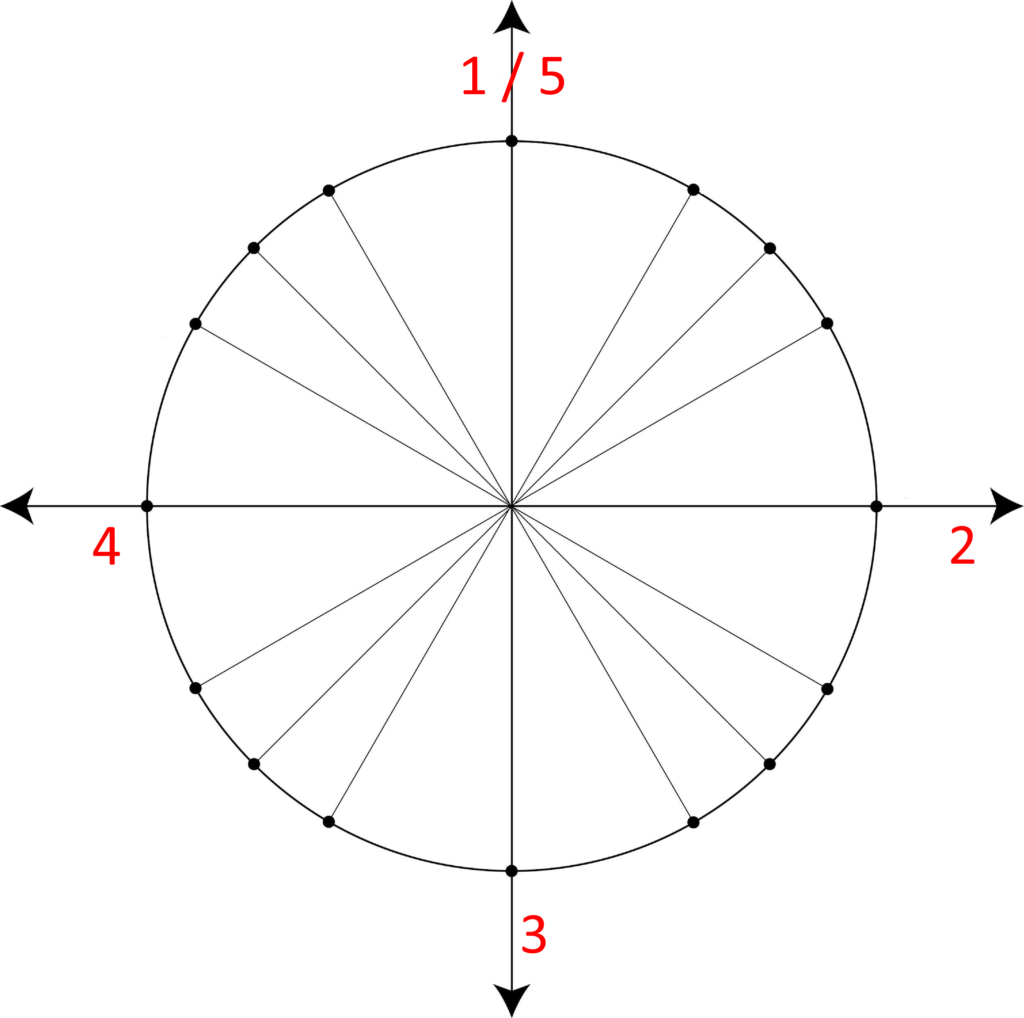
The unit circle is the basis of trigonometry and…
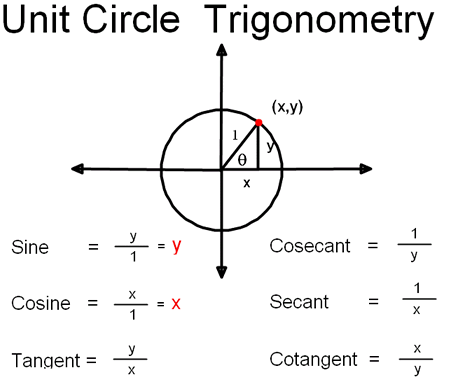
… trigonometry is the basis of spherical trigonometry

and spherical trigonometry is the basis of understanding earth, space, and the universe.

Let me summarize:
We started with a seeming aporia. We decided to treat it like a black box, we gave it a name, and continued to apply the established rules for calculating and equations, which led us to the equation of 1 = 5.
We found that this seeming nonsense does indeed make sense in the unit circle, which is the portal to trigonometry, provided we treat 1 through 5 not as cardinal integers but as ordinal numbers. Trigonometry, however, is the portal to spherical trigonometry, which is the first step to understanding the universe and to navigation in Earth’s atmosphere and in space.
From a Deist perspective, the exercise shows that the universe can be described and understood using mathematical concepts developed by the human mind. It also shows that our calculating rules make sense. It further shows that the universe has a mathematical structure of complex intelligence and that humans can understand this structure or, currently, at least part of it.
The exercise further illustrates how the black-box method of thinking can be successfully used to turn a seeming dead-end into a door opener that sends us on a trajectory to deeper understanding of reality on a higher level of abstraction.
I should add that we can calculate with imaginary numbers as if they were regular numbers, applying the established rules of calculation and equations, and we can use them to build bridges that actually hold and airplanes that actually fly. If you apply the black-box method to other situations in life, you may find that what seems to make little sense at first, turns out to make a lot of sense – just change your approach or perspective and carry on.
Circling back to Deism, the principle of the circle allows us to understand concepts we can otherwise not easily wrap our minds around such as the concepts of endlessness or eternity. If we look at a straight line with no ends, it is on principle endless, but we cannot really understand this concept of endlessness. But if we draw a circle, its circumference is also endless but in a manner we can understand. Endlessness or eternity are typically among the defining characteristics of our concept of a creator God and even of the universe. If we try to define endlessness as an endless line, we cannot imagine or understand it, but if we define it as a circle, we can.
Revelation 1:8 reads: “’I am the Alpha and the Omega’,” says the Lord God.“ God defines himself as the beginning and the end. It is in the (unit) circle or in similar shapes that the beginning is also the end, and the end is also the beginning.
You may call this exercise a scientific approach to faith or a rationalization of the irrational or you may simply call it basic Deism. I hope I was able to show that knowledge and faith are not necessarily mutually exclusive but can be complementary. The “God” in “God bless America” is not a religious God, not one rooted in any specific religion or faith. It refers to a neutral Deist God that is accessible through reason, thus emphasizing unity, not particularity. E pluribus unum.
The French mathematician Blaise Pascal, who lived between 1623 and 1662, claimed that he had an epiphany. God spoke to him for two hours. After this, he was still not prepared to accept blind faith as a way to God. However, he had also lost his trust in pure reason. He came up with a compromise, a wager. You could also call it a what-if theory. Here is Pascal’s Deist wager in a chart:
| Your Bet / Your Options | God does not exist | God Exists |
| You don’t believe | You gain nothing but you also lose nothing | A finite loss. Eternal damnation. |
| You believe | You lose nothing that really matters | An infinite gain. Eternal happiness. |
Like it or not, we are all in this wager. We cannot escape it. For the Deist, believing in God represents the smaller risk of loss and failure, which makes faith a reasonable choice.